

CASE STUDY
Helping the City of White Rock Explore the Use of AI
Turning recreation data into actionable insights
Project Overview
The City of White Rock engaged Gravity Union to support a structured AI learning initiative focused on Parks and Recreation data. The goal was not simply to introduce a new technology, but to build internal understanding of how AI could be applied to a real operational challenge. Through the project, staff explored whether previously underused and difficult-to-organize recreation data could be made more accessible, searchable, and useful for decision-making.
The project resulted in a working data agent, stronger data foundations, and a repeatable model for future AI initiatives at the City. It also demonstrated a practical way to approach AI adoption: Begin with a real operational challenge, improve the underlying data, and use AI where it can provide meaningful value. This allowed the City to make progress on an existing business need while building internal experience with an emerging technology.

About the City of White Rock
A medium sized municipality in British Columbia, located 45 minutes south of Vancouver near the Canadian American border
Affectionately referred to as the “City by the Sea”, a popular destination known for its beautiful pier and promenade
By the numbers
The City of White Rock has 185 employees
Their IT team has 7 employees
They serve a municipal population of 24,000
Technologies
Xplor (recreation management software)
Azure
SQL (Database in Azure)
Fabric (AI capabilities)
A TWO-FOLD CHALLENGE
Mining recreational data by experimenting with AI
As a smaller municipality, the City of White Rock was not looking to experiment with AI for its own sake. There was no dedicated AI budget, no formal Council mandate, and limited capacity for projects that did not create clear organizational value. Any investment in AI had to be tied to a real operational problem.
That problem existed in Parks and Recreation. The City had used Xplor Recreation for years to manage programs, registrations, and attendance for services such as swimming lessons, art classes, and other community programs. While the platform contained valuable data, staff were mostly using it for basic reporting. More complex questions about revenue, demand, participant demographics, travel patterns, and marketing opportunities were much harder to answer.
Gravity Union and the City used this challenge as a practical test case for AI. Rather than starting with a technology solution and searching for a use case, the project began with a business problem: Parks and Recreation had data that could support better decisions, but staff needed a better way to access and explore it.
Together, the team set out to build an AI-supported tool that could help answer questions such as:
Which programs generate the most revenue in the least amount of time?
What age groups are growing fastest, and where may additional classes be needed?
How far are participants travelling to attend City programs?
Are participants coming from outside White Rock?
How could marketing efforts be better aligned with participant demographics, location, and demand?
The opportunity was not simply to “try AI.” It was to take data the City already had, improve how it could be used, and test whether AI could help staff turn existing information into practical insight.


If we are going to invest time and credibility in AI, it needs to produce something useful for the organization. Even a modest tool should save time, reduce friction, or improve access to information.
Chris Zota, Chief Information Officer, City of White Rock
A MULTI-FACETED SOLUTION
Clean(er) data, an AI tool to answer complex questions, and a more confident team
The Process
A crucial step before beginning this work was to understand the current limitations of the recreation software. Xplor provided primarily transaction data, which is the action taken by residents, like signing up for a class. The software lacked deeper reporting, like demographic analysis to understand what classes are most popular with seniors.
So once the team identified their need—using data to identify patterns, relationships, and common themes to understand why trends were emerging or where opportunities existed—it was time to map out the options of how to best move forward.
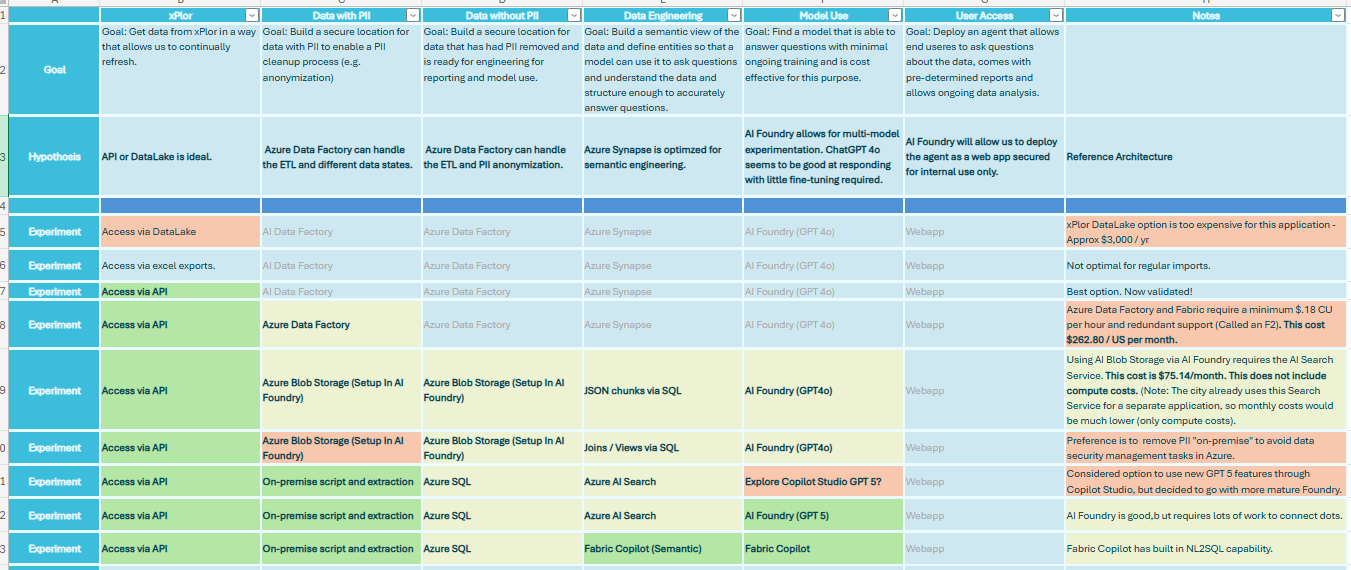
With Gravity Union as a partner, The City was able to build an experiment table to quickly hypothesize and test which technologies would help to best solve the problem.
The Data
The Tool
Using this collaborative model, The City and Gravity Union decided to:
Use the xPlor API as the data source
Remove PII before the data enters Azure
Store and engineer data in Azure services (SQL/Synapse)
Use AI Foundry with GPT models for question answering
Deliver the final experience through a secure internal web application
There were unknowns here, too. Could AI help with unstructured data? How much would need to be cleaned, and at what cost?
Data engineering prepares data so it can be used effectively. Gravity Union helped refine and protect the City's data by improving quality, removing sensitive information (PII), and restructuring key fields. For example, instead of storing birth dates, the dataset captured residents' ages, preserving useful demographic insights while reducing privacy risks. The project also highlighted that poor data quality comes at a cost, as AI would otherwise need to repeatedly clean and interpret the data with every query.
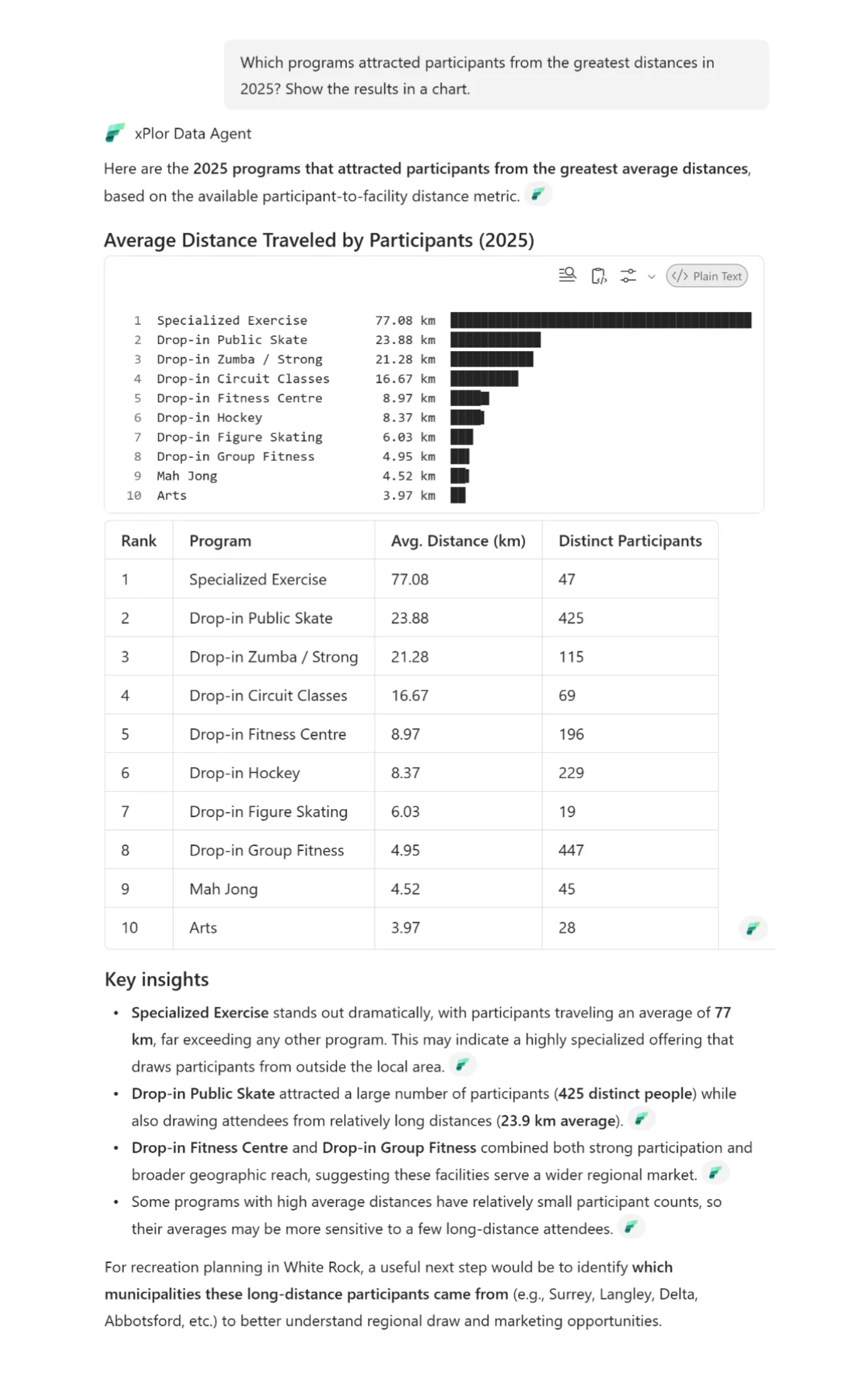
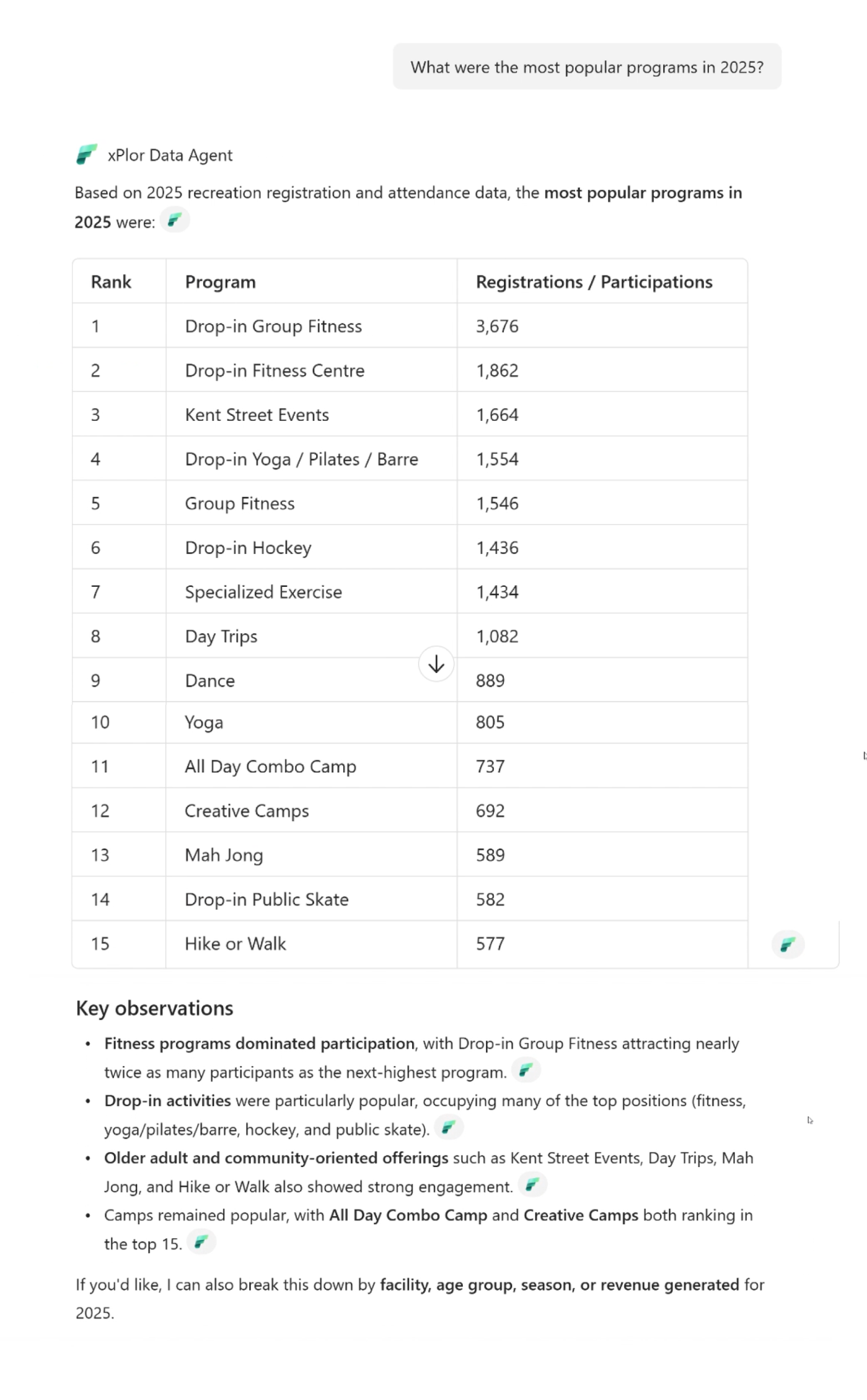
With structured data in place, Gravity Union built an interactive AI data agent that allowed City staff to ask questions conversationally and receive nuanced answers that were not previously available from the simple Xplor reports.
An agent was a better fit than a traditional report because the team did not need a fixed answer to a fixed question. They needed a way to explore the data as new questions came up. A report would have required the team to decide in advance what they wanted to see, such as where participants were coming from. The agent allowed them to go further by asking open questions, testing ideas, visualizing the results, and digging into patterns or anomalies they may not have known to look for at the start. For example, they could explore whether someone who completed a level one workshop went on to complete level two, and whether that happened right away or much later. This made the agent more than a reporting tool. It gave staff a flexible way to investigate the data, follow emerging questions, and uncover patterns that may not have been visible through standard reports.
The Team
-
Total attendance per class
Number of registrations per session
Registrations by residency status
Wait list counts
-
Which classes are trending up or down year over year?
Which age groups are driving the most registrations (and revenue)?
What percentage of participants live outside White Rock?
Are there patterns in when and where wait lists spike?
-
Smarter decisions about which programs to expand, scale back, or retire
More targeted programming that more accurately reflects community demand
Clearer view of registrations patterns by residency status
Better use of existing facility time, and whether capacity could be redistributed
Chris and his team brought a practical, learning-focused mindset to the project. For a smaller municipality, innovation is not always driven by large budgets or formal programs; it often comes from identifying a clear problem, testing a focused solution, and supporting staff through the process.
By focusing on both the learning process and the outcome, the City developed a practical template for future AI initiatives. The partnership with Gravity Union helped staff build confidence with AI while reinforcing a responsible, problem-first approach to using emerging technology.
Being a smaller organization can actually be an advantage. It allows us to be creative and responsive. You do not need a large budget to innovate—you need a clear problem to solve, a willingness to learn, and a commitment to supporting your people.
Chris Zota, Chief Information Officer, City of White Rock
A partner that helps you stay ahead
✓
A partner that helps you stay ahead ✓
White Rock's AI initiative did not happen in isolation. It builds on a long-standing relationship with Gravity Union that spans more than eight years, including previous projects such as the City's bylaw chatbot. Throughout that time, the focus has been on helping White Rock get the most value possible from the Microsoft technologies they already own, while exploring new ways to solve business challenges.
White Rock brought the municipal context, an understanding of the technology and data being collected, and a close working relationship with Parks and Recreation. Gravity Union brought a team that is constantly testing, learning, and applying emerging technologies before they become mainstream. Together, the teams explored how Microsoft 365, Azure, Power BI, AI, and Microsoft Copilot could be used to support practical, real world municipal needs.
As part of this project, Gravity Union helped White Rock explore what AI could do, but also how to use AI while also protecting where and how data is processed. Together, the teams experimented with different approaches, challenged assumptions, and learned what worked best for their unique needs. The result was not just a successful solution, but a deeper understanding of how AI can be applied responsibly in a municipal environment.
For organizations evaluating potential partners, the difference is simple: We do not just deliver technology. We help clients navigate change, make sense of rapidly evolving tools, and confidently adopt solutions that create lasting value.
"Our working relationship with the City of White Rock is always collaborative and symbiotic. From day one, both teams brought important expertise to the table.”
Michael Schweitzer, CEO at Gravity Union
"This was not just about delivering an outcome. It was also about learning how to use AI responsibly and practically in a municipal context. And Gravity Union understood and valued that from the very beginning."
Chris Zota, CIO at The City of White Rock
Could your organization benefit from a similar approach?
We do not just deliver technology—we help clients navigate change, make sense of rapidly evolving tools, and confidently adopt solutions that create lasting value.

Explore more client work
-
Technologies: SharePoint Online, Power Platform, Azure & Cloud Services, ShareGate migration & Foxit PDF Maestro. Read the full case study.
-
Technologies: SharePoint, Power Automate, & Power Apps. Read the full case study.
-
Technologies: SharePoint and Collabware. Read the full case study.